Friday, July 14, 2006
Normal Body Muscle Percent For Men
By Josep M ª Fericgla, PhD in anthropology, published in Catalan in "Revista de Catalunya d'Ethnology," No.. 15 November 1999, pp. 120-127 - by the Department of Culture of the Generalitat de Catalunya, Barcelona.
is difficult to write something about the universal Carlos Cesar Arana Castaneda, without it being a mere invention, a personal interpretation of the writer and without any criticism or mystification, which obscured any reality. We will try, therefore, to make a small tour of his recent biography so far verified the facts permit. From there, every one to his free interpretations of what is present. Some of the following data are taken from the research that Edith Stanley, Patrick Kerkstra and Scott Glover, researchers at the U.S. Los Angeles Times newspaper have done on the recent death of Castaneda.
His life
The universal author known under the name of Carlos Castaneda, witch autodenomindo follower of shamanic traditions of the Yaqui Indians, Americans, died on April 27, 1999 in Westwood, USA, as reported his attorney Deborah Drooz, which is presented as a friend of the writer and executor of his will.
Despite the thick fog and mystery, scattered volunteer-involving the life of Carlos Castaneda, we know that he emigrated to the U.S. in 1951, and said that he was born on Christmas Day 1925 in Sao Paulo (Brazil) or in Cajamarca (Peru), depending on the autobiographical accounts that want to believe. It is very probable that this was the son of a South American family who emigrated to the U.S. to study. In this sense, some voices, in my opinion quite authoritative, say their families had Catalan origin and that his real name was Castaneda, a name quite widespread in some Catalan regions which would mean "forest of chestnut trees, but they migrated from South America to the U.S., and in the absence of sound and spelling" ñ "in English, lost his family Castañeda for his new Castaneda .
Meanwhile, our author was a liar and a cheat without limits and never regretted it, hence the scientific community has never paid it serious attention, although many times it said and reiterated that told was true and that there was no fantasy in it. However, despite being given credit for his stories, the truth is that the details of his biography-so far-fetched by researchers mythomaniacs detractors as fans, are a sum of pure hypothesis darkened with meticulously. Nothing is clear, beginning with the date of your birth date or the place where it happened. Even there are serious doubts about the veracity of its official name. One might think that this is precisely the strategy of the witch, that he had so often repeated in his books, to escape enquilosamiento of a past that is forming a crust on top of each and every time he keeps rather live like a warrior. You can also think that a person like Castaneda shown elusive to the press and helps to shape their own myth by removing his fingerprints from the past even the smallest details pero que en algún nivel de su intimidad aparece un Carlos desenmascarado, pero resulta que no, que incluso alguien tan próximo a nuestro autor como el psicólogo Richard Yensen me comentó, cuando estuvimos juntos hace unas semanas, que Castaneda era un mentiroso permanente, que uno nunca podía fiarse de lo que decía. "Gran parte de la mística castanediana se basa en el hecho de que, ni tan sólo sus más íntimos amigos están seguros de quien es", escribió su ex-esposa Margaret Runyan Castaneda, en un memorial que se publicó en el año 1997 a pesar de que el propio Castaneda trató de impedir que se editara. Así pues, nadie puede esperar que la academia de científicos, preocupados por la objective truth, show the least willingness to believe or to check something from the pen of a supreme liar the only verifiable aspects of their lives.
Regardless of who was this man, his name and date and place of birth, the truth is that our author managed to galvanize and catalyze global attention thirty years ago. It is widely known that as the final work for a Ph.D. in anthropology at UCLA, Castaneda did what many students of anthropology at the end of the race, chose a theme, place and ethnicity on which to perform the research to the Academy, but what came out was recalling the Arizona desert trip in Mexico. His original intention, if we are to believe us his story focused on searching and studying the effects of certain medicinal plants traditionally used among the peoples who inhabit this arid corner of the world wide. But fate never forgive: he stood in a town bordering the desert of Arizona and there on the same bus stop for Greyhound, the most popular in the U.S., began a change that would transform as person, he and much of Western youth. Once located and not knowing what the fate that lay in the bus terminal met an old Yaqui Indian ethnicity, supposedly named Juan Matus, Don Juan, who said to come from Sonora, Mexico. If we continue to believe the story told by Castaneda, the old man turned out to be a shaman who consumed entheogenic plants and those used to initiate his pupil and into a hidden world that survived for more than 2 000 years.
Under the heavy, strong and wise tutelage of beloved Don Juan, which lasted over several years, our author experienced the effects of peyote, of various entheogenic seeds and fungi probably psilocybian, learning experiences and moments of supreme ecstasy but also painful and dark inferno of panic. All this in an attempt to know and live what he called non-ordinary states of reality. Wandering through the desert with his guide and teacher psychological and ethnobotanist (just in the cataloging of plants, the only thing that can be seen from outside, is where Castaneda fails more), the anthropologist said he saw giant insects, having learned to fly with new peak, having transformed into a crow and finally triumphed in order to achieve a higher and more refined level of consciousness, a man of knowledge as was Don Juan.
His thesis, published in 1968 by the University of California, soon became a literary success international. It touched adequate fiber and at the right time of the crest of the wave of young American culture of the years 1960, consuming psychedelics and romantically in love with her pure and native sages. The style of the original works of Castaneda, a style that will never leave her, was a curious and suggestive blend of universal allegories, anthropology, parapsychology, alchemy and Buddhist philosophy, and-probably-a good dose of fiction. In my opinion there is also a good dose of the lessons of a century earlier disseminate G. Gurdjieff and his own outstanding disciple Ouspensky. That was how his first book, The Teachings of Don Juan. One way yaki towards knowledge, made the old character of Don Juan in a name rather than revered among young people and Castaneda in an authentic cultural symbol.
In one of the few articles written about him and cooperated Castaneda, published by Time magazine in 1973, said: "For the tens of thousands of readers (Castaneda), young and old, the first meeting Castaneda with Juan Matus (...) is best known literary fact that the meeting between Dante and Beatrice on the banks of the Arno "... Indeed, it is. After such an impressive literary debut, our author continued to produce best-sellers such as A Separate Reality, Travel to itxlan and Tales of Power. As a result, given the childish and impetuous character between that characterizes our neighbors across the Atlantic, crowds of young and not so young was rushed to New Mexico students hoping to become the wise cast feet of Don Juan, journalists began to investigate the life of the sorcerer and his now famous disciple ... yaki but the old Indian did not appear anywhere, "unlike what had happened to the shaman Maria Sabina .. This gave rise to speculations about the reality of what is narrated in the books of Castaneda, some people accused him of being the author of a witty and well-crafted hoax that does not correspond to reality Traditional ethnic and announcing. Skeptical criticism was a good representative in Joyce Carol Oates, a famous author who turned to the arguments of veracity, in 1972 asking "Is there any possibility that these non-fiction books? Everyone accepts them as anthropological studies but I seem to some remarkable works of art, Hesse style when writing about the initiation of the young in another kind of reality. They are beautifully constructed, the dialogue is impeccable, the character of Don Juan is unforgettable and all enjoy a great rhythm novelistic. " It can not be true. For its part, the renowned anthropologist C. Geertz, also said that "for Now his books without any presence in the field of anthropology "in the sense that, despite the popularity obtained any university professor of anthropology seriously recommend these texts to their students. However, no trend Castaneda for lying or the most questionable real existence of Don Juan have decreased at any time the enthusiasm of their fans. In this sense, Joshua Gilder, editor of the Saturday Review, said it is not necessary to believe and have faith to feel drawn by Castaneda's narrative, it is the reprocessing of universal myths, act weird and wonderful effect that is beyond the realm of belief. It something only a genius can produce.
Despite much criticism, or just because she said in the last days of his life, Castaneda insisted strongly that the facts he had recounted in his books were not only real but were meticulously documented. Also repeated to the 400 people who attended a seminar given by him in Anaheim, in 1995: there said and reiterated that he had not invented anything, it was crazy.
In my opinion, and after my years dedicated to research of entheogens, their effects and importance in every human culture, I am not mistaken in asserting that these fields of human endeavor is very, very safe to say that something is real or not. The effects that psychoactive substances have many shades of gray. In this sense, I felt for years, and over time has been saying to myself, "that the great trap of Castaneda, his big lie, is what tells it how it relates, when plants autoexperimenta entheogenic, one sees ordinary worlds, but it is also true that I know no one in their right mind would claim that such worlds are really out of the subject. Are inner worlds though, very often have some sort of reverb or empathy with the environment. Thus, to refer to these psychological dimensions of our universe, it is necessary and essential to use linguistic metaphors. Not for nothing absolutely all, religions advertise their truths and discoveries in a metaphorical way: the Tao of Buddhists is nameless, like the One of the Christians, and to refer to these stocks transcendent no choice but to use images metaphorical. Believe that Castaneda was cheating when he put the metaphor in the words of Don Juan ineffable but announced that the way to explain their experiences was also a metaphor. Often, in my experiences with ayahuasca, san pedro or other entheogenic use the same forms of expression (I've flown by ... I've seen ... I felt the vastness ... I died ... my body is transformed ...) and do not announce that it is the effect of entheogens on my own mind, it is likely that some take me for a madman and other by a prophet, like Castaneda.
His death
Despite all this, our author deserves to be applied to all the highest honors English genius and figure ... since his mysterious sorcerer life is also reflected in his death.
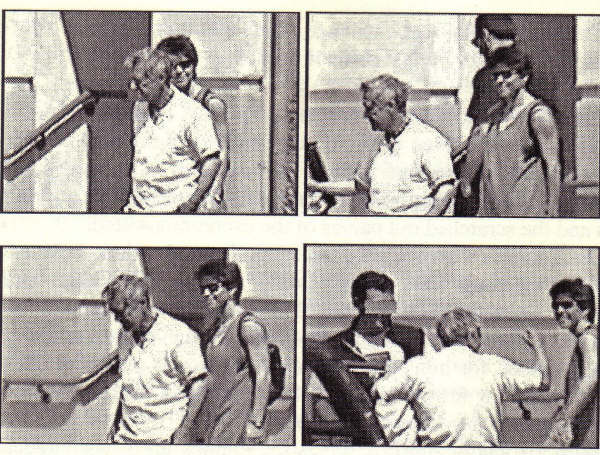
The stated cause of his silent and anonymous death was liver cancer. At least outwardly, died as a result of his life in recent decades and the content of his teachings, away from the madding crowd, without advertising or chambers, in the most scrupulous, free and perfect anonymity. In his photographs are not less than forty years old or recordings of any kind, and caring very much that in his very few public appearances, no one recorded his voice or photograph the image: hence the striking photo that appeared newspapers in late June to announce his death, portrait taken in 1951 which is a round-faced man, postwar styling all in one tiny technical quality. A sorcerer, Castaneda said, he never looks at his past and these systems to freeze the image of a slow evolution of the warrior inside.
Nor, it seems
-funeral took place at all. His body was cremated in the U.S. and then scattered his ashes in Mexico, according to records contained in the morgue of the American city of Culver. However, these data are not reliable because no or only his official death certificate is free of ambiguity and lack of information. In it, and according to the Los Angeles Times, said that his occupation was teaching at the school district of Beverly Hills (Beverly Hills School District), but no school in this district has recorded or any file that Castaneda taught there. It is also said that our author had no family, but the death certificate shows the name of a niece, Talia Bey, who turns out to be the president of the company Cleargreen Inc., the company organizing seminars Castaneda on "tensegrity," a modern and somewhat frayed version of the supposed shamanistic practices for energy, which clearly comes from a part of yoga, another martial arts and even ergonomic exercises elsewhere. However, it has not been possible to locate T. Bey to add more information on the subject.
In this sense, it is surprising that the official record of death, according to the Los Angeles Times, Castaneda appears recorded as Nev. Married, "never married" when, in contrast, is known of his marriage to Margaret Runyan Castaneda, from Charleston (W.Va.), which lasted between 1960 and 1973, and a son that is not recognized by Castaneda, not under oath before a court. This assumption son is now 36 years old and lives in Atlanta. He keeps claiming to be the descendant of the famous author and it claims to have a birth certificate as the father figure as Carlos Castaneda. However, none of this is really clear, despite investigations by E. Stanley, P. Kerkstra and S. Glover. The cloud closed around him.
When few weeks ago information was requested on Castaneda's death his ex-wife alleged, M. Runyan, 76, she replied that nobody had informed him that he knew nothing, but he was already worried about his death for years, said it would be the best experience of his life. In 1995, while teaching the seminar in Anaheim, our author's stated publicly that: "... we are all facing the infinite, whether we like it or not Why do not we do it while we are weak, when we are with health broken or when we are dying and why not when we feel strong? Why not now? " Instead, in contrast to these explicit statements of the last three years is its position when he was interviewed for Time magazine in 1973, then was much more succinct when discussing end of life of the journalist's attention diverted to a graffiti that was on a wall in Los Angeles which stated: "Death is the rush strongest of all. Therefore we reserve it for the end."
Our illustrious author has left a will that must be read and validated during the month of July in Los Angeles, and a questionable certificate: perfect end to a life impeccably hazy. The few people who could legally leave benefit of its rich and juicy copyright was advised of the Castaneda's death by his attorney Deborah Drooz, but nobody told the press or any other media until 18 June (died April 27.) For its part, the doctor who attended their last breaths Castaneda, Angelica Duenas, not known to have spoken with anyone quite referring to this as patient confidentiality. Even those who, apparently, had our author as one of his close friends knew nothing about his death and later when they were reported not spent even a moment to publicize the death of your friend to anybody . This was his tribute to Castaneda and his contempt for the public, respect and dispensing dimension of reality to be the author.
Michael Korda, author and editor who published a book of Castaneda from the publisher Simon & Schuster said that he had been adopted as standard practice in his life ever challenging or anyone related to the industry media about Castaneda, let alone about his death. Neither Tracy Kramer, Castaneda's literary agent in Los Angeles, has returned even one of the calls received or asked to comment on the subject. Instead, it has merely cite the same texts Castaneda, "according to the tradition of the shamans of his lineage, Carlos Castaneda left this world in full consciousness."
As short summary of his life because, dare I add only that Castaneda was the author of ten books translated into seventeen languages, books that have caused a revolution in Western thought in the second half of the twentieth century. One American observer said it was the first and chief ideologue of the so-called New Age, but in my opinion, who has carefully read his books will probably agree that in them is the possibility of deception, twisted fantasies extremely well and other virtues and qualities, or otherwise, but, at least from the old and weathered and Europe-is difficult to see in the spirited and a champion male Castaneda of the somewhat flabby New Bober. I do not think he would accept.
In any case, the issue is not whether it is true or not, in a physical sense, the content of their stories, but in extremely suggestive of his books, as readers and act on the mythical space involved in the current situation anyone would wonder if there was a flesh and blood Oedipus to corroborate the veracity of the myth or metaphor used to explain our psychological maternal dependency? You would not ...?.
Source: http://www.geocities.com/Area51/Dimension/9522/entrevista9.html
Saturday, June 10, 2006
Can Levequin Be Adminitered As A Shot?
| By Martin Solares, published in SELF Magazine, 1994, Mexico. According to reports from Octavio Paz, José Agustín, Jaime Garcia Terres, Juan Tovar, several intellectuals who remain anonymous and Carlos Castaneda.En 1976, the hippie culture was still in full swing with his slogans of peace and love , his interest in Zen Buddhism and techniques to achieve enlightenment, when generalized interest of young Americans by the psychedelic experience and began to publish the first scientific work on hallucinogenic mushrooms and the books of Tolkien spoke of great and unexpected worlds ; appearing twelve years after The Lord of the Rings, ten years after On the Road, a young Latino finished writing a report that would allow graduating as an anthropologist at the University of California at Los Angeles (UCLA). It was the third version, third. The previous two had been dismissed on the advice of their teachers. One of them, Professor Harold Garfinkel, Ethnomethodology pioneer in this university, made a simple observation that contributed invaluable in shaping the style of the young tesista: while aspire to earn the title of anthropologist, the student should record their findings " direct and detailed manner, avoiding subjectivity that attempts to explain what happened: avoiding appear. The writing of this third version had taken several years during which he had to work as a taxi driver and messenger, among other jobs similares.Quizás never suspected that the results of their report would impress more than one student in California Unviersidad. Perhaps Anaïs Nin never imagined that public would be interested to see this work published, and even believed that the prestigious publishing house would print the UCLA Teachings of Don Juan, forcing it to disappear after the name of Carlos Castaneda.CRONICAS OF A WITCH IN MEXICO1970 : The millionaire publisher Simon & Schuster seeks to buy reprint rights to the thesis of a young anthropologist who has become a bestseller. Meanwhile, in Mexico, an even younger writer tries to convince Joaquin Diez-Canedo you publish this argument in the editorial Joaquin Mortiz. The writer named José Agustín Ramírez and then know that the thesis in anthropology was recommending that took several months to sell an average of 16 thousand copies a week in the Unidos.Don Joachim and not remember why not publish the thesis in anthropology the editorial office, and at that time "so many books coming ..." 1971: Unlike Diez-Canedo, Jaime Garcia Terres, editorial advisor entonses Economic Culture Fund, it comes in contact with the director of UCLA, August Frug, and reasonable buys thousand dollars for the rights of the thesis for publication in Castilian. Garcia Terres, a pioneer in the interest for the study of hallucinogenic mushrooms, decided that the first edition of The Teachings of Don Juan in Castilian occur which should be whole, and the cover charge to Leonora Carrington, the introduction to Octavio Paz and translation Juan Tovar, the latter on the recommendation of Ten-Canedo.1972: Castaneda travels to Mexico to meet her enthusiastic publisher in the Economic Culture Fund, and presented to several employees of the institution: Alba Red public relations director of the editorial, Adolfo Castanon, the translator Juan Tovar and his wife, Elsa Cross. José Agustín also meets and begins with him one of his most enduring friendships with a Mexican. It feels so pleased with the work of Garcia Terres that facilitates their publication in Castilian following works, including A Separate Reality and Journey to Ixtlan, which had recently appeared in the American Union, with a lag of several months and immediately become bestsellers.1973: Time magazine enterprising unsuccessfully-a worldwide research, particularly fierce in Mexico, where its reporters combing several states of the republic for evidence of the existence of Don Juan. In its issue of March 5 of that year, Time published an interview with Castaneda and the only known photographs of him: a close-up of his eyes and whole body image of someone who, leaning on a desk biblionteca UCLA Read a book and covered his face with a hat paja.1974: Carrying a copy of Tales of Power, his fourth book published in the United States, Castaneda made a trip to Mexico during which assists a meal that your friends will offer in house and Alba Vicente Rojo. He is accompanied by three women who presented as his wife, sister and sister. According to descriptions, it could be your partner, Florinda Donner -A Venezuelan novelist whom many taken by Swedish-, the writer also Taisha and learning his girlfriend, Carol Tiggs, respectively. During this visit to Mexico, Castaneda also sympathize with Hector Manjarrez and Fernando Benítez. A friend of Garcia Terres going to look at the Hotel Camino Real and is registered under the nobre "Carlos Castaneda" 1975: Returns to Mexico. Visit José Agustín and Jorge Fons, accompanied by Juan Tovar. From this year, his next stop books published in the Economic Culture Fund, due largely to his friend Jaime Garcia Terres, then deputy director of the editorial, leaving the institution. During this period and until the end of 1976, visit the Federal District on several occasions, one of whom is interviewed about sex and witchcraft for men's magazine El.1981: Upon learning that José Agustín translate to El Don del Aguila Castilian commissioned by Editorial Diana, Castaneda called to say hello and maintains a telephone contact with the writer. When the book is presented in the capital of the republic, few months later, Castaneda attended incognito to the event, and, standing in the audience, grins and shakes hands with a dumbfounded José Agustín on the stand. When three years later appears in The Fire Within Mexico, announces its participation Castaneda in a couple of presentations to be carried out in the library of Daniel Cosio Villegas Economic Culture Fund, and the CUC. From both exits to feel besieged by cameras. Some amateur photographers insist on that night several of his rolls out for a biography velados.APUNTES NO AUTORIZADACarlos Castaneda turns 27 in 1995. The person behind that name will celebrate its 60th birthday on 25 December that year. The first is a pseudonym, the latter a doctorate in anthropology from Brazil that had its first esturios in Argentina, took a course in fine arts in Italy and finally entered the Unversity of California. Both claim to have been initiated into witchcraft by a Yaqui Indian named Juan Matus. The two had completed their training over three vast sessions: from 1961 to 1965, from 1968 to 1973 and from June of that year, the month in which Don Juan died to date. 1974 was still possible to find teaching students of anthropology at the University of California, and was often heard how the latter aimed at him and said to each other "Hey, that's Castaneda", as they walked through the halls of the university . If you look from afar, writes José Agustín, Carlos Castaneda and Carlos Cesar Aranha Castaneda surprised by its resemblance to the actor Peter Lorre, but close is less than average height, complexion, dark complexion, curly hair, and physiognomy mestiza "he recalls Juan Tovar. You can not put it in a racial type specific because it could come from any Latin American country except Mexico, because, as agreed several interviewees, "there is something in his profile and not Mexican." Nor would it be easy to attribute a source to analyze his accent, he speaks English like a gringo, easily used words of Portuguese and English usually runs a ubiquitous, with expressions from various parts of the continent, such as "Kiko and Kako", "San whore" or "son of a flute." For a novelist who insisted not to be identified, Castaneda always behaved in public as if ised a performance, dropping red herrings af in creating a wall of fog around their identity. It is possible that the words in Portuguese muro.Según are part of Mexican intellectuals who have tried, the author of The Teachings of Don Juan usually cancel commitments unexpectedly-sometimes by Florinda Donner, arguing sudden illness or unavoidable obligations. All emphasize his ability to relate to people and great sympathy. Several agree that it has never provided your address and phone their friends, at most the number of a PO Box in Los Angeles or data his literary agent in charge. Likes to call their friends at all hours of the night, but hangs up if an answering machine answers. Sometimes said to be in a city when it is actually in another. Whenever he decides the time and place for interviews, and no wonder planted to stop a person if the looks of it does not seem reliable. Does not encourage anyone to use drugs and was not seen drinking wine, marijuana or other soft drinks bottles. Karate practice daily. Wears conservative clothing, usually in autumn colors. Not enrolled in any public association. It may take several months to respond to messages from the editors of any country. Bored to find more sinister objects within the letters he sent several years ago ceased to thoroughly check your mail. It was not always witnessed by the writer Carlos Castaneda.Como Florinda Donner in Being in the Dreaming, a susu most recent books, his learning partner also lived under the names of Jose Cortez and Isidoro Baltazar, the first of which corresponded to undocumented worker alleged that the couple who worked at a coffee shop in California as a dishwasher also wrote a libro.TAXONOMIA OF CASTANEDITASUna visit to Coyoacán esoteric bookstores reveals an interesting variety of books that discuss, refer or even continue the saga of Don Juan and Carlos Castaneda. Taisha and Florinda Donner-who lived his apprenticeship as a witch along with Castaneda, have written about such experiences. Less talented than the others, there are several novels "inspired" in the saga of Don Juan, and also sold. Among the serious studies about Castaneda stand Castaneda Test-an anthology of escritorres Americans on the topic-and almost inconseguible Castaneda's Journey, by journalist Richard de Mille, the same as Juan Tovar wanted to translate to the Fondo de Cultura Economica but Garcia Terrés "is not encouraged." De Mille presented a well documented report seeks to reveal the private life of Don Juan Matus apprenticed. Despite of Richard de Mille and other tests to Castaneda, some buyers of these books not only view them as a literary proposal, but Mexico vital.En Castaneda's followers are among the most diverse. The vast majority do not and never has been attending practice sessions where exercises varied. One writer, after four years of knowing him and sympathize revealed that assists me for five to a kind of esoteric workshop, which declined to give further details. His teacher is someone who claims to know other line naguales Castaneda. And whatever you have seen there is very astonished man of letters. Federico Fellini recalled that after they make known their intentions to film Teachings Don Juan, received several death threats. And a number of Mexican intellectuals who requested anonymity recalled that some of the most enthusiastic lectoers Castaneda were people professionally engaged in witchcraft, advisors esoteric Mexican VIPs, bodyguards and other workers who tend to abuse of brute force. Given this, several of my interviewees suggested me not delve into that aspect of the investigation. And I did not. But while working on the intellectual part of the story, got an unexpected an address in Los Angeles, so I called a friend from Los Angeles Times and asked him to go to the upmarket residential area of \u200b\u200bWestwood, near of Universal Studios. Once there, he stopped at the guard booth, pressed a button and asked for "Mr. Carlos Castaneda" by going to the video camera watching him from the techo.EN NAGUALPara THE ADDRESS OF 1991, Castaneda's books reached 257 authorized editions worldwide, photocopied circulating in countries of the Far East and the United States alone had sold eight million copies. Simon & Schuster, Penguin Books and Gallimard are some of the editorials that have broadcast his work. In Mexico, each of his books published in editorial Diana (The Gift of the Eagle, The Fire Within and The Power of Silence) has spent about 250 thousand copies, while sales and reprints of up to 20 thousand books of The Teachings of Don Juan, A Separate Reality, Journey to Ixtlan Tales of Power and the Economic Culture Fund as comparable to become a bestselling authors such as Octavio Paz or Carlos Fuentes, and only less than Francisco Rojas González, Juan Rulfo and Mariano Azuela, the latter above 500 thousand copies vendidos.Según Fausto Rosales, his editor at Diana, the amount that Castaneda received editorial concept advances is not to be scared, "especially if you think that authors like Carl Sagan ever receive tens of millions of dollars for the rights of one of his books." Rosales, that has Castaneda treaty, insists that money is an unimportant issue for the writer, and it does not live as a millonario.Una visit, on the pretext that it is "within his department revealed a collection of more than 260 copies of his work published in different languages, a picture painted by the daughter of Jaime Garcia Terres, books by poets such as San Juan De La Cruz, César Vallejo and Dylan Thomas, a receipt from the Master Charge credit card, a book by Florinda Donner dedicated "to the aranha that takes me on his back, and two cars in the garage, pick up a cream and a brown four puertas.Castaneda Ford, who has not lost its athleticism, now used short hair is completely gray. Says one of her neighbors that "if you are 60 you will not be noticed." And not everyone knows who he is. Something has to see that Castaneda has rejected the offer of one million dollars that American Express was to announce your credit card for just 15 seconds. Owes something to its strict decision not to allow his films bring to cinema, "not to see Quinn Antohny making Don Juan", and their increasingly remote appearances. Still struggling with poor translations of his books into English, and acostrumbra disappear for a few months each time you publish a new book, alarming his seguidores.En Once, he says, he simply took a small suitcase called a taxi to the airport in Los Angeles and walked through the halls hata he felt the call of one of the airlines. He and Florinda Donner uan began several weeks visit to Asia. When asked if someone gets completely invented what happens in his books, jibs immediately: "I could not have invented Don Juan Matus", and claims that his books were written by a complex merger process that seeks to "set the assemblage point to get to see again the facts that one seeks relatar.En Mexico, most intellectuals agree on three things: 1) They appreciate that Castaneda's books are so well written and respect him as a writer, 2) as Octavio Paz said, less interested in the mystery surrounding the identity of Castaneda "the enigmas proposed by his work", and 3) highlight their ability to work with images. Jaime Garcia Terres insists he has never used the word "fraud" to refer to the writer: "Have you ever told a man who gave in to his imagination, which is very respectable and creative" Juan Tovar agreed that Castaneda is living the myth that building, "and we built" and is convinced that his stories or tales of power are, like Borges's theology, a branch of fantastic literature, each new most accomplished book narratively than its predecessor and "harder to swallow as a document." Along the same lines, José Agustín, who has not disdained to speak or write the theme rather than tiredness, believes the author of The Art of Dreaming and The Second Ring of Power "is a fascinating path of human development and exploration serious, honest and intelligent in many real possibilities of the human mind, and that his "autobiography sui generis' worth anthropological, philosophical, psychological, esoteric and literary. When at last my friend at the entrance to the residential area of \u200b\u200bWestwood received a response The silence was broken by a woman's voice spoke a single word: "No.There that was it. |
| |
http://www.geocities.com/diablisima
Sunday, May 28, 2006
How Many Orgasims Should A Man Have
Saturday, April 1, 2006
Red Spot On Penis Shaft No Pain
Mexico City, July 16, 1982
Sunday, March 26, 2006
Wednesday, March 15, 2006
Brazilian Wax Arlington Tx
By Héctor Loaiza, published on the site Resonancias.org, 2003.
Mexico City, July 17, 1982
At 7 am, Carlos Castaneda, dressed differently than the day before, I was waiting in the cafeteria of the Sheraton Maria Isabel. This time wearing a gray sport shirt with open collar over the lapels of his jacket also gray. In fact you could not figure her age seemed to be an eternal teenager. But his wrinkled brown face looked like that morning have been split further, carrying the logos of those addicted to peyote. Maybe it was fatigue, since he had slept very little (like me).
My first question Castaneda was "locked" for he had given a taped interview. He suggested I write it because he could not speak to the recorder, cold and mechanical control. I had to shut down. We talked until it without him noticing, turn it on again. The following is the result of a two-hour interview. HECTOR
LOAIZA: What has been your training, what books you read and which authors have influenced your work?
CARLOS CASTANEDA: At the beginning of my apprenticeship with Don Juan, I was a very conscientious student of anthropology, studied and read widely. So I prepared enough to talk to him about the uses of peyote. Once don Juan gave me an interesting joke, I said I had made in vain. "I prepare well," he added, "then the rabbit jumps unexpectedly in different places!" He warned me that I would not contribute to interpretations based on my reading of what he was saying. It was a wise decision on his part, since we had started great discussions. For me, had doubts about him. That man was a fake that I was cheating. With regard to the use of peyote was referring to the highest authority, Dr. Weston La Barre (1) (considering it as the ultimate authority was an aberration). But at that time believed in the authority of La Barre to the things that Don Juan was saying. I thought: "That old man does not know an iota of the uses of peyote, speaks as La Barre. There is nothing I can recognize what this animal, which has written the great Professor La Barre. "Short of that was very wise, I could not do otherwise.
HL: Through your books were best sellers in the United States and Europe, concludes that Don Juan exists, is real, and now lives in the imagination of your readers.
CC: No. Don Juan is like Carlos Castaneda, another character. It is the Nagual, the leader of a magical cycle and as such, Don Juan Matus is a great importance. As a social person don Juan did not attract attention. Furthermore, not only is an important figure in his magical cycle, but also testified to the circumstances that made him a character.
HL: Carlos, since yesterday, I noticed that your vision of beings and things is fictional. Because talk of "character" Carlos Castaneda, the "character" Don Juan. For you, reality is a fiction and Mentioning quote: "It's just a description."
CC: Yes, indeed. But it is a shared description. Humans are involved in a consensus that is challenging in the everyday. Consensus particular group of witches linked to the character Don Juan Matus, the Nagual, can spread and cover a longer number of participants.
HL: Can you explain a little more magical cycle of Don Juan?
CC: Don Juan says that according to a Toltec myth can transcend the biological sense of death. A man can be freed from the compulsion to die and can die in a different way. Don Juan calls it the "pursuit of freedom." Magic is a cycle that has nothing to do with perceptual units of our everyday world. The group of Don Juan is closed, not because it itself is an esoteric group, but simply not interested to reach people abroad. For unavoidable reasons, he conceived it was part of my cycle to approach strangers to him, without me being Indian or had anything to do with their tradition. Don Juan as a social person comes of course from one ethnic group. I had great difficulty in finding out where it came from the Nagual, I never said it, not because it was a secret, but reveal it just was not interested. If there are people looking for where I come I is not about me. If they are right and if not, that's not important! Don Juan wanted me to erase the traces of my personal history, but never told me how! Index is a category so vague as such as "college." Nobody really knows what "college." Everyone can have a different opinion, but we use the word as effectively as if we shared the uniform meaning of "college." Don Juan wanted me to do that with a method so vague as to erase my personal history. So the "fix" the contradictions of the philosophy of Don Juan, happens when one makes an "attempt" to carry out artistic and that's important to understand Don Juan and behavior.
HL: In one of your books, stories the way don Juan made you closer to your view of death. You said that "we must live with his death next door."
CC: course, is the world's reference style warrior Don Juan. The warrior must constantly refer to the inevitable end. Only when one takes, as Don Juan says death as a point of reference, without morbidity and without feeling embarrassed or offended, then you can actually overcome the natural meanness of life. Don Juan said that we live as immortals, without accounting for our actions to anyone, as if we were eternal. We afford to lose time and beating around in crap. I am convinced that Don Juan was right. It's a much more interesting approach to life and not my family, who live in terror of death and yet wasted their lives. How awful! It's a terrible way to not realize what they do!
HL: There are two attitudes towards death, the first is to have a morbid idea, for example, is to worship death. And the other is the suppression: not to think about it. This is what happens in the West, where people try to forget at all costs will one day die.
CC: Don Juan In that sense, where tradition is unique in considering that death is a point of dissolution, a reference to everything we do. But he wanted to transcend death and change. Knew what was coming, which will inevitably be extinguished. But the option adopted to change the finality of death and consciously transform it into something else. Do not want to leave his body (as I said last night). This seems an absurd idea, I can not conceive naturally and West that the intention of Don Juan had validity. Do not leave the body is absurd. And that was what he wanted for himself and his group, who were able to transcend that thing that death is inevitable and let the living force to escape from the body. He considered that the living force had sufficient capacity to transform the body into pure energy, as opposed to what happens to us men everyday world. We let the living force to escape the body and it is terminated as a dead body, inert. To me that is unique not know any author who has given me an idea similar to that of Don Juan in his pursuit of freedom and the transformation of the body into pure energy.
HL: Your words make me think of reincarnation, what can you say about that?
CC: Don Juan believed that believe in reincarnation is to give us too much. We are so unique that we will not return to the world, again and again, to refine our splendor. That would be absurd. For Don Juan are not made in the image and likeness of God. It is inconceivable! That is a huge aspect of Judeo-Christian selfishness, that of believing unique beings, made in the image and likeness of God. Don Juan used to say that accidents are beings who will die. That's it!
HL: In last night's conversation has outlined the idea of \u200b\u200bgetting rid of the emotional world of feelings. And it seems you've succeeded ...
CC: Indeed. After many years of practice, at one point I had a very serious illness, so I went to the doctor. He had what is called the "hyperventilation", that's what I thought. But it was not. According to the ideology of Don Juan, "was losing the human form." Well, I never took seriously. My logic did not allow me to believe that one can lose the human aspect, not even understood what don Juan meant. For him, "losing the human form" meant entering a state of detachment. But do not get to it gradually, as knowledge or "be aware" that is important to lose that addiction. Comes suddenly. A day comes when one loses the human form and the next day is wrapped in an unfamiliar feeling, inexplicable. So Don Juan lived.
HL: There is this notion also mentioned last night that is detachment, which I think is an eastern influence.
CC: comes a time in which the learner feel they have no more attachment, which the world has no force or coercive value had the previous day. That's the secret. The world requires us to act a certain way. In that sense they are important and extraordinary sophistication of the conclusions reached by the witches or shamans (as we like to call Don Juan). For them, "the world is a perception" and we are the ones who perceive it. Up to us to give you the meaning of one or the other way, not just cultural. And if we say, it's about my culture, my education, that relieves us of the responsibility to act. For Don Juan that is not important. We understand that the world is a perception and as such it is then possible act on it and change it. And we have to change the tenor of those perceptions. To achieve change in a way so subtle and yet so dramatic, it also changes the meaning of the world. It ceases to be fixed and barren, endless, incomplete, as we perceive as normal. Don Juan covers all that and takes it to its climax.
HL: When you said that detachment is not a rational concept, intellectual, voluntary ... The fact that it occurs suddenly, do not you think that is a kind of mutation?
CC: Yes, Don Juan and the members of his clan claim that morphological change is a man who suffers at the level of energy field and a mutation does not simply mean spiritual.
HL: This mutation then psycho-physio-biological.
CC: Of course, how we might understand a complete change, but more than that Don Juan believed to be a power shift. The man becomes energy field. Nagual says the pressure is like a seesaw in the state and the warrior training. That pressure, a good time is so strong that drives change in biology. Then the total change is not that one is repressing. I do not control, and desperately try not to get angry for example, or being off, it would be nice! Is not interested, I extinguished the interest. How do I relate to the world? What is important to me is the character Carlos Castaneda, and I have no link that binds me to the world as a person. The only way to bring this bridge to the world through the character, exactly as did Don Juan. He said he had no history. But I struggled like a demon following my anthropological canons, to find their history, their origin, their vital data. He never stopped me, that does not give a damn! But I always thought that Don Juan was tight, did not reveal anything, it seemed as if he had something to hide. Now I'm in the same case, I have nothing to hide. However, now I understand the behavior of Don Juan, he was a character, had lost the human form and could only relate to the world as the Nagual, the leader. I have not gotten to that state, I'm no leader or head of anything, but if I lost the need to perceive the world.
HL: in Europe is said that your books are always a critical position, very Western, and that's supposed to create a need in Don Juan to explain. Or on the other hand, I clung to the standard Western sense because you were too afraid to stay in that non-ordinary reality
CC: Both views are incorrect. Faced with the dissolution of perception, one is so vulnerable and so weak that there is no way to describe the feeling, the desire to have one to comfort her. This is important when one is pounding with the unknown, fear is an earthquake, biological, which has no name. This is not the fear of death. The psychological fear of dissolution is infinitely more important than biological extinction. And one needs to make use of all elements, bastions, ramparts, of everything that one can rely. At the same time I was very interested to ask Juan what was happening, he would tell me. Needed a more comprehensive elucidation. The only way to force don Juan was asking. I'm in the same situation now, if you ask me I no I can not explain anything. You have to ask and so I am compelled to explain. Some of his apprentices never asked anything, failed to "hook" intellectually. And they don Juan, the Nagual, was very different than it was for me. An apprentice never really understand what you are practicing. For my part, I understand what I'm doing, as I have the safeguard of the reader, I can not defend what is wrong with Castaneda, saying, "Oh these are monsters of your imagination!" I have to assume greater responsibility. I overtake the phenomenon it and understand it or took me Mandinga! There can be no way to accommodate me. I have to understand what is happening and so I have a minimal support.
HL: Carlos, you said you were not Indian, you said also that very well assimilated the teachings of Don Juan to "erase your personal history." In France they are surprised by the fact that you cut your roots, you have nothing to do with your past. On the other hand, now that I've heard reivindicarte mestizo, cholo, against the world's cultural values \u200b\u200bCreole, Hispanic, I think that is the wealth of your thinking.
CC: The fact that it is "cholo" Of course! That's what gives me a number of assumptions that involve contradictory points. The only way to resolve these contradictions is an artistic way. When I say I'm not Indian, I mean a cultural sense. What I have seen consistently in Don Juan had been that he took as an apprentice to a person born and raised in an Indian reserve in the United States. I come from outside, outside the context of Don Juan, did not even have an idea of \u200b\u200bthe Indian context of Don Juan.
HL: Thanks to the fact that two cultures come together in you, you were the only person who could capture the attention of Don Juan.
CC: The Nagual, as a seer, was able to see energy fields and saw in me the right power to undertake this learning. The fact that I was culturally assimilated to European thought became my support. But while I was distracted and I was braking the "overall intent." Let me be perfectly aware of my background, could not be otherwise! I had to take into account what was to pursue what don Juan wanted. He demanded that one is faced with itself without any passion, is in fact one of the highlights of their ideology. I forced myself to make my life count, and when I say that not be back again to where I was born I say in a sense that it I counted. Don Juan insisted that it was possible to give what he calls the "Eagle", the final force, which devours us, giving us support and created us. The Eagle, is the sum total of all living things on earth and beyond. You do not know the enormous potential biological, organic, conscious and the sum of all that is there. The Eagle devouring consciousness in the Toltec myth. If you give sustenance to the Eagle, in the sense of making a full recount of the events of your life, you will be free. But to make that count one ends with the feeling, that which makes us beings of the world. Don Juan ended roots. Because it forces us to be rooted bias and fills us with false security, gives us the idea of \u200b\u200bbelonging to a group, a tradition. That in itself keeps us flying! We removed the idea that we can stand on our own, we can go out, break of that fence that has created the world around us. And that's all I can think of an explanation. But you are obliged to take into account who you are to be able to make that break. That happens only when you know who you are. One thing that always bothered me is that I'm chump, short, dark-feito as Don Juan, in a tall white people, because Americans are looking, well done. So I was full of desperate complex. Don Juan believed there was no way out of this impasse. Go to a psychiatrist so that I arrange my feelings, to don Juan that was not the remedy. The important thing was to cut everything. The Nagual said that those who were born alive in the clouds we were princes. Then I was an ugly prince! Every time someone kept me in a balloon and I out the air, I fell to the ground frequently. Don Juan recommended that a walk on the ground, so low. That was fighting themselves, without lies, in a indestructible. Because if no illusions about what one is, the presentation of self in everyday life has another aspect, takes on a different meaning. There is no need to introduce ourselves as the prince or a person of great importance. Then that presentation is much more accurate, one is no longer the guy in the sky!
HL: What has attracted attention in Europe in your books is learning through psychotropic drugs to "pop" the way to the non-ordinary reality. What has allowed you to get into the so contradictory and frightening dimension to this Don Juan I drove.
CC: He was interested in my power to put the idea that the "intent" believe everything I perceive. The world is in my power as perceived through the magic of "intent." The only way to realize that the "intent" is a force manageable, by psychotropic drugs, especially for someone like me who then had "deep convictions" on the world. World was a misunderstanding and therefore immutable transcended me. And Don Juan believes that the world exists but I do not exist, but does not exist in the same sense that I perceive it. The world is not there with clouds, mountains and valleys unless I, a man who perceives, is not there. Because for Don Juan not only am he who sees, a man who works with stereoscopic vision, allowing me to perceive the world from an anthropomorphic perspective, but I learned to drive this vision through teaching I gave the society, to channel stereoscopic vision of man as descended from apes. I'm ready to see the world in a way, by my ideology. And the end result is that I perceive the world as a human being, that the world exists but I do not exist. The important thing for Don Juan was to understand and get my body to understand that this vision can be canceled, it was just a way to "see" the world. Although I like being over, adult, had not yet used the scope I was under the influence of a psychotropic came into play. Once this has been "trying", Don Juan was able to make available to my body the idea that I have more room than I think perceptive, then it is not necessary to use a psychotropic drug. I can not use it excessively, without purpose.
HL: But there were a series of abuses on the part of readers, you have taken at face value and wanted to reproduce the atmosphere that you described in your books.
CC: Can not play the context of Don Juan. At the beginning of my work I took great care to play and record everything he did. I learned ballet system used to encode the movements. Then coded gestures that don Juan did with the eyes, hands, feet, reaching to reproduce faithfully. When I went to the mountain don Juan picked up several leaves and bushes, mixing, the bruised and put them on my belly. That kept me warm all night without blankets and freezing cold. I came to collect seven versions of different plants and different ways to collect, bruised and applied to my body. When I tried using all the resources of the archives, to reproduce what don Juan had never worked, ever! And Don Juan laughed a lot, made fun of me, I was fascinated by the idea of \u200b\u200bme gave me so much trouble to point out his every move. He said that sooner or later I would realize that everything was related to "try" personal power. And one day he said: "Look, I'll end up with these hobbies take yours notes. "Having looked at the jeep he needed, he ordered:" Put this table rotten in the belly! "I put it and I had the same effect. For a long time believed that was the power of suggestion, the finally understood that Don Juan was a master of "intent".
HL: say that Don Juan as a shaman was the performances, the metteur-en-scène, who controlled the stage. stress the fact that this control over you used his hypnotic powers.
CC: Well, I always thought that Don Juan, and others close to him I beguile, to the point that I could explain what happened as a state hypnosis. Now I come to another conclusion. Don Juan the "master of intent" (do not know, English is not the right word, I would say the "master of intent") as an original wizard, not just to suggest something and leave me a mirage, immersed in a state hypnotic. At some point in history, man was able to handle the "intent" and of course bring up the rabbit in his hand. When man ceased to be master of "attempt," came the prestidigitation, the rabbit is now hidden in clothing of the magician and he pulls it out at the right time. But Don Juan did appear rabbits, not only for my vision. "intent" is what makes the world. The Teachings of Don Juan beyond my logic and my way of explaining the world. Being the master of "attempt" to Toltec sorcerers, Yaqui, Mazatec, who formed the group of Don Juan, meant to "control" what is the world's creation. For example, Don Juan once made to appear here in Alameda, Avenida Juarez, a squirrel in his hand, he had glasses and looked like a Japanese. What I could not get at the moment and could not tell you how to solve the case.
HL: The great success enjoyed your books on Anglo-Saxon countries is that much more attracted the message was the claim of the road individual. It is also by example, not by ideology or by an oral discourse, the shaman leads the master-apprentice to the understanding of certain phenomena of non-ordinary reality.
CC: Don Juan did not believe there is a body of knowledge, to which an apprentice may be referred, not to have internalized all the precepts of that body. I did not think the kind of action is suitable for psychiatrists, because I had my experiences while working in the office of a psychiatrist conducting surveys with people who had problems. And Don Juan was horrified by the idea that a person who helps, a psychiatrist, also has problems. I said: "What do whatever! "A superman?" Don Juan replied, "Of course, one has to require the help is a superman, that is free from all defects and meanness to interpret and suggest a behavior. Otherwise, what it does is validate himself. "To him, that had no meaning and of course the apprentice was all that existed. This, in the words of Don Juan, had to be impeccable if I wanted to be persuasive with him. The apprentice had to put all the components of his being on the table. If it was not flawless, monolithic in their behavior, he could not move anyone, had no personal power. The "intent" does not move. If I leave from flawless, if I had a double life, public and private, could not even go to the corner and there would be way to make the "bridge" I need at this time to move. It is the "intent" that moves me.
HL: in our American mentality we like to sing boleros about ourselves or we ourselves also like "novels roses" on our ego.
CC: We are colonial, tremendously influenced by all that is Europe. In Latin America live with one eye on the U.S. Embassy and the other, in France, awaiting influences. It is not something that we can avoid. Look where we are you and me: you are in France and I am in the United States. And there is no other way.
HL: In a conversation with Octavio Paz a few days ago we talked about the big issue between Latin America and the United States is cultural. We did not understand and yet are part of the same continent.
CC: Don Juan once gave me a very strange idea to me, told me that what I had to deal with something he called the "Torquemada" (2). What I had in me was not so much the European artist, the thinker, but the Inquisitor. And that's what he called the support of Europe and the totalitarian versions are not fetched, are not foreign visions. We are the inquisitors themselves! The Inquisitor's spirit carries within it the coercion, imposed on the other in a total. Don Juan said that his philosophy was the product of coercion than five years of indexes and archives as well as coercion of thought. Torquemada tremendous as it was pure and believed killed in the name of God, on behalf of a superior ideology unchallenged. The Nagual said that with such men had no way to fight, that was impossible. Only the warrior can escape the influence of Torquemada, who loaded us all up. That means freedom from yourself!
HL: In our continent is to replace a religion of the book, Catholic, on the other ideology derived from the Bible.
CC: Like all Latin, as you very well know how we are, when I met Don Juan, was imbued with ideas on reform and social injustice. Actually, I thought it might be useful politically or ideologically from a classical viewpoint. The rebel who wants to release bombs and revolution. Don Juan finished with all that my membership. He said: "Look, if there is someone between the two that should complain, it's me, I'm Yaqui Indian" I thought he would have to complain and not me. In the end, the Yaquis do not interest me as such, interested because they would put aside a more important: the salvation of the individual. I as an individual, not as a cultural element, understood the teachings of Don Juan of the best possible way, in my own interest. I put aside everything that meant social position. It is one of the criticisms that I made the night of the conference. They believed that Don Juan was not a shaman, in the sense that he had no social function.
HL: I referred several times to the fact that you were the "bridge" between Western civilization and the world of Don Juan. Could you explain this notion of being a "bridge" between these two worlds?
CC: would be impossible for the reader to go and talk to Don Juan. One criticism that I have done, is not having the sources of my information. If what I have told is true and must be taken seriously, I am obliged to present the sources: to bring people to know Don Juan, who speaks of his experiences, to say what he thinks and what it is. Don Juan could never do that, because he had no interest in doing so. In addition there are Americans who met with Don Juan, how they could have found me! If I were him I would have no incentive to disclose to anyone what I'm doing, it would be absurd! It would be tremendously superfluous close to me, as if imbued with the aura of Don Juan. If I were like him, there would be no way for me to say anything to anyone. Don Juan I used to me as a "vehicle" to express certain principles that governed his life, I had enough energy to undertake the task of conceptualizing, explaining, what don Juan was in his magical cycle. How do you explain Don Juan the world, the idea that he was one of the characters in a myth? I think there would be impossible and nobody approached him. When searching for the "Don Juan" of my books, of course it never was the Indian who was in front of them. If someone is found with Don Juan as the culmination a real search, the Nagual imprison him instantly and that person is out of the world. The compulsion of the warrior who is involved in this mythic cycle, is to bring freedom to anyone who approaches him. Don Juan gave me the task of explaining the universe, not because it concerns me or give me profits and in no way involves me. It's something like a term that comes from outside! If I leave me on my own, it would be impossible to meet, I talked to them, for what? But the Nagual "Unfortunately or fortunately, I was given the task of writing books and presenting them in the world. Never had to deal with this phenomenon and there was no way validated in terms of Western man his own existence. Not because it is hidden and has depths that separate us. With respect to the original question, how do I feel like a "bridge"? Don Juan chose me as a tight link between representing himself and the amorphous quality that we, the westerners. He's just locked up, and we are open to the point that we see nothing.
HL: I am interested in the randomness, chance encounters the most important thing you can do in life. You told me that Don Juan has chosen you, that you do not chose, but you got to him. What is the explanation?
CC: For Don Juan is the question of "intent" that governs the destiny of man, but the "intent" is not human intention. For him it is a major force that moves us, imprisons us. The "intent" is to tell the version of what we would know as God. The "intent" is not what Don Juan called the Nagual, the inexplicable, which can not be transcribed, that which has no form, is the All. While the Tonal is order, is an island of order, purpose, serial, equations, cycles of thoughts. All that is known to us in our role relacionantes beings. The "intent" is a force that is part of the Nagual, which can be describe and you can feel. And what applies this cycle is a matter of "intent" as a force that Don Juan found, so I came across on their way.
HL: The most admirable of your books, is the great sense of humor, ie not fall into the serious and solemn as ... Now that I know you understand because you have a sunny personality, a humorous view of life that is truly beneficial.
CC: That was the total insistence of Don Juan, cured me of the "long face and the ass of lead," the extraordinary weight. I was a man of great seriousness and of tremendous grief, nostalgia was feeling sad, sorry for myself, I pursued day and night. Don Juan cured me and that was a catharsis!
HL: I pointed out a contradiction, how to be the philosophy of your life that is truly funny is reconciled with a taste for poetry so sad and so tragic as that of César Vallejo (3)?
CC: As a distraction, I would read poems by Don Juan Vallejo and others who knew nothing of books. Spent hours talking with them. A Don Juan, he liked to pick just one verse of each poem, never more than one, said that verse summed up the whole vision of the poet. Beyond a stanza were complaints and cries. To show the truth of his assertions, don Juan made me read these poems and say, "Look, go back and read this part, that's the only thing worth in this poem, that's beyond absurd. The poet should have shortened his poem and leave it at four or five lines. " To me, I liked to read poetry very cerebral, Francophiles, that Don Juan did not like being too frivolous, were verbosity, crap. For me, Vallejo represented the end, as opposed to the position of Don Juan. "The second verse is an aberration, a grotesque" he said.
HL: I'll give you my personal opinion about the work of Vallejo, and not for the sensitive of our time. I see very Christian, very suffering that took five centuries of suffering of Peruvians.
CC: To me, I do not like César Vallejo, I feel extremely childish way bothers me about the idea of \u200b\u200bthe complaint and the staff crying. When I read in its entirety Vallejo me nauseous, too sad. To Don Juan's idea of \u200b\u200bthe conception of a human being is important, it should have been done by his parents with an extraordinary sensuality to give the child all possible options. Don Juan believed that it was an eyesore to conceive children in the ennui, boredom, take them after years of marriage, having acquired subsidiary that love has nothing to do with passion, but with civilization. Planning for the child after years of marriage, for Don Juan was a monster without a name, so awful as to have animals neutered at home. He said once the animals come from an irrational beings, we eat a power directly. They relate to an energy beings and not objects. Once I found a sparrow that had fallen from its nest, a rat had eaten a wing. Then I grabbed the sparrow and I tried to cauterize the wound, so it does not bleed. I told don Juan that he would pick the sparrow in my house, jumping with two feet without flying. Don Juan told me: "If you like monster Professional slave and dependent on you for everything. It is better to leave that is coupled with the Nagual, with the infinite ... "Don Juan said that the great tragedy of our time was the influence of beings created in disgust, and so were miserable beings who could not move by themselves dependent on the world, were burdensome, heavy, weak cry and complain ... and César Vallejo. Then the intelligence, melancholy, to me are an aberration. A horrible thing! appears that Vallejo was the son quinzavo of a marriage. Ugh
HL: I lived a very difficult time, you know everything that is told about prejudice in Peru early twentieth century against the Indian, mestizo, the cholo and these prejudices continue. The fact that in a famous poem complains of being treated "huaco" (4) is significant.
CC: That is the merit of César Vallejo. With Don Juan, we conclude that in fact terrible things happened to him. Don Juan used the "vehicle" of César Vallejo as a didactic element to me. As for myself, the idea of \u200b\u200bhow badly they treat me, I am reliving that situation and I am involved in another life vallejiana. He managed to escape the prejudices that are tremendous in the side of the world where I live.
HL: I think that's the problem with being "different." Any person sensitive, as the poet Vallejo. And in your case, this sensitivity to the surface and being aware of your "difference" will always have problems in any country where you live.
CC: Unless you behave like a warrior. Vallejo didactic vehicle for me was a uniquely important: Don Juan used Vallejo's life and his poems as an example of what you should not do.
HL: I've seen do not want to reveal details about yourself, you avoid the publication of your photo. This comment often heard in Europe: What happens to Carlos Castaneda? Are you or do not live up to what people ask? What as someone who was initiated into the secrets of an ancient gnosis, can contribute to our critical time?
CC: Well, the only way, I need to find a suitable word, convincing, so that I can persuade you. Again using his ideology, Don Juan insisted that the actual man is the "pirate." It does not ask, but grab what you can! The pirate is a loner who feels best in their loneliness. Do not cry, do not complain or cry! Because it is given its "piracy" and this gives a reason for being. As we are so far from where we come from, we got where we are. I think my assumption is correct, you and me are two pirates. So that I can convince other "pirate" as I can persuade him to have to produce a tangible result.
HL: a magical.
CC: would have-in the words of Don Juan, "" stop the world. " He felt that everything is a game of perceptions and therefore is a mutable thing. Organized beings have created a perception system that consists of perceptual units. Change the tenor of these units of perception, is to "stop the world." If I could, for example, do at this point a "miracle of intent" could then persuade you.
HL: If you have an atom of wisdom, being aware of what is happening in the world. I think that wisdom should be used to contribute with a grain of sand that does not end badly. I think the "hacker" needs to use all the cognitive elements to avoid the worst.
CC: Okay, I'm terribly disagree. The reason I said that my life was monolithic and that was to be a perfect man, only through the sinlessness could reach you or persuade another person to be like you. If I could not make that reassessment of energy, it would be impossible to apply the teachings of Don Juan. It would be a tremendous waste of time, because I could not reach the final synthesis. What you say is imperative that a contribution with a grain of sand and I am with you in a hundred percent, would provide that. The only way to do that for me is to stay within the canons of the teachings of Don Juan.
HL: I liked (I think it is the French translation of "A Separate Reality") the story: When you make the difference between the Yaqui has surrendered completely to alcohol, the victim of events, wants to own material objects, a motorcycle. And the difference with the Yaqui as Don Juan who has kept his inner self and has managed to reveal that diamond of wisdom that was in it. I think in that situation and there is the germ of an ethical project.
CC: precisely what gives pragmatic value to the conduct of Don Juan, is that it does so from a viewpoint of an ethic of "warrior" who totally transcends Christian morality. There is no interruption in their ethical concept as a whole person extends to cover everything. Between us, the world is split, we have an ethic that relates to politics, jurisprudence, a special division. There is an ethic that transcends the fractionation constant. Don Juan's conduct was that of a warrior which means a record total. His interest was guide, had no such interest in making friends always said I had no interest in making a slave for his mission.
HL: How can a man or a character like Carlos Castaneda was born in a remote part of the northern highlands of Peru (Castaneda laughed as if he liked my insistence that he publicly acknowledged that he was Peruvian) has been arrive at what has arrived?
CC: Indeed it is impossible to explain. Everything I think our luck. It is not possible to believe that we who come from what they call the "Third World", we rely solely on the work, talent. If we are unlucky we are nothing. Luck plays the ultimate role and is "trying." In my case it is an "attempt" stranger who comes from outside is not explained. You do not know how to explain it, you personally what happened in your life. I interpret it as luck, as something ethereal, as if I had smiled at the Dama.
HL: Or have a lucky star.
CC: That is the most appropriate way. Once one gets to the goal, is essential sinlessness that creates a link to the "Lucky Star." It is no longer an arbitrary thing of chance, something hasty.
HL: take the breath is needed. One may be born with a "lucky star" but without the vital impulse, then you end up practicing a worldly philosophy, snob ...
CC: Or just as a poker player with a lot of luck (laughs), making a fortune at baccarat, roulette.
HL: There are many people who are aware of what you say, what you write. What can you say about drug use?
CC: Don Juan told me, if one could see himself in a brutal manner, without passion, without mercy. If one were to understand, first of all, the idea of \u200b\u200bconception. If one was conceived in boredom, it is inevitable the use of drugs, the wiles of the supports easy as chemicals, psychoanalysis. According to Don Juan, modern man is the result of what he calls "boring caught." The individual who is a product of desperation born jaded intercourse, no matrix, no direction. If that person could have a brutal addition of itself, as would-be Don Juan-a miser of his power, and keep it for free from the tremendous needs, such as cigarettes, alcohol ... It must be that this dependence is due simply to a general discontent. The use of drugs is just an expression. Don Juan believed that was a reflection of how we were conceived.
HL: In Civilization posindustrializada, the father no longer fulfills its role. In fact, the father is the television. The father is no longer the educator of their children. For me, the ideal image of father would be the master ...
CC: One of the most terrible things that happened to me in my relationship with Don Juan. It's what made me realize what a child that we, boys. If they see with the eyes of the Yaqui sorcerer you will notice that we are engaged in a series of games and that women are much stronger. It seems like another species, however we are only children. That is a product of our time. Now the U.S. is more noticeable than elsewhere, you see a gentleman of sixty years boy feels, and that drags everyone, even women, in search of childhood, of immaturity. But youth is not what they want, do not want to be young. They want to be kids!
HL: In Europe, in France, I hear the same women facing the crisis of society and the alleged failure of male power: "The fault is that of men, they are the ones that have made wars. "
CC: One of the supports of the ideology of Don Juan is the idea that women are basically over. And no discussion! As a male chauvinistic coming from South America, it took an egg to accept this position. Now I have no problem in accepting it in all its depth. It would be a revolution if women did not have to rely on conjunctive units stolen from the man's masculinity. They do not need to be displayed as "butch."
HL: That is the risk of imitation of male power.
CC: Why would imitate the man, if he for them is the usurper? See them dressed butch, lesbian with a mustache. No kidding! That's too brought the hair!
HL: What do you see Europe from here in America?
CC: I see very old . Heh, heh, heh! Terribly decayed, intellectually hollow. I like America because you say there are no borders. They are wild children of bitches, as they say, but they have the youth and the initiative! Instead Europe, wrapped in terrible struggles of decline, is what Don Juan called Torquemada. ----------------------------------------------
------------------------------- (1) Weston La Barre, American professor of anthropology, author of "The Cult of peyote. "
(2) Tomas de Torquemada (1420-1498), religious preacher, organized the Court of the Inquisition. Reyes was appointed by the Catholics as inquisitor general.
(3) Cesar Vallejo (1895-1938), Peruvian poet who lived from 1924 to 1938 in Paris, where he died. In his poetry denounces injustice, misery and misfortune that has befallen the man, praise the humanism and solidarity.
(4) Ceramics pre-Columbian civilizations with anthropomorphic, faces, especially in the Chimu and Mochica cultures that developed on the coast of the department of La Libertad where Vallejo was born.
http://www.geocities.com/diablisima
Tuesday, February 28, 2006
Coby Dvd Remote Distance Sucks
Interview with Carlos Castaneda for Self magazine, February 1997. By Daniel Trujillo Rivas
The number for January / February 1998 Utne Reader magazine, is the article "The World Conscious Dreams" by Michael Brennan, containing extracts from, and another interview with Carlos Castaneda .
Q: Mr. Castaneda, for years you remained in absolute anonymity. What has led him to leave that condition to devote today to publicly disseminate the lessons, along with their current partners, was the nagual Juan Matus?
Answer: What compels us to spread the ideas of Don Juan Matus is the urgent need to clarify what he taught us. I and three other students have come to the unanimous conclusion that the world we had Don Juan Matus is viewed by means of perception of all human beings. We argue among ourselves what would be the right path. "Anonymity as Don Juan told us to? This was not among us a pleasant echo. The other route available was to disseminate the ideas of Don Juan: a path vastly more dangerous and exhausting, but the only one we believe has the dignity with which Don Juan imbibed his teachings.
P: Considering that you said that the acts of a warrior are unpredictable, and in fact we have proven for three decades, can we expect that its public phase is prolonged in time? How long?
R: No way to set a time criterion for us. We live according to the assumptions proposed by Don Juan and never turn away from them. Don Juan Matus gave us the terrible example of a man who lived as he described. The monolithic example of a man who does not have two faces. And I say that is a terrible example because it is harder to emulate, to be monolithic and at the same time having the flexibility to address what was, that was the way of life of Don Juan.
Within these premises the only thing you can be is a perfect conduit. One is not the player of the cosmic chess game, one is simply a chess piece. Who decides everything is a conscious impersonal force which sorcerers call the Intent or Spirit.
Q: As I have seen, orthodox anthropology undermines the credibility of his work, as well as the supposed defenders of American pre-Columbian heritage. There remains the belief that his work is purely the result of his literary talent, of course, exceptional, while other sectors are accused of a double behavior, because, supposedly, their lifestyle and their activities are contrary to what most expect of a shaman. How can you bridge these suspicions?
R: The cognitive system of Western man forces us to move through preconceived ideas. We base our judgments on something that is always "a priori", for example the idea of \u200b\u200b"orthodox." What is the orthodox anthropology? Is taught in the classroom? And, what is the behavior of the shaman? "Putting feathers on their heads and dance to the spirits?
have accused Carlos Castaneda for thirty years to create a literary character, simply because what I said did not match the "a priori" anthropological, with the ideas set out in the classroom or anthropological scope. However, what I had Don Juan could only fit in a full scope, and under such circumstances happens very little or almost nothing preconceived.
I could never reach conclusions about shamanism, because this needs to be an active member of the world of shamans. It is very easy for a social scientist, say a sociologist, sociological conclusions about any topic related to the Western world, for the sociologist is an active member of the Western world. But how can an anthropologist who spends at most two years studying other cultures, draw conclusions reliable about them? To purchase membership in a cultural world needs a lifetime. I have been working for over thirty years in the cognitive world of shamans of ancient Mexico and sincerely believe that I have not yet come to acquire the membership that allows me to draw conclusions, or even propose them.
I have discussed about this with people from different disciplines and always seem to understand and agree with the assumptions I am making. But then turn and forget all that and agreed to continue to maintain academic principles "orthodox" regardless of the possibility of an absurd mistake in its findings. Our cognitive system seems to be impenetrable.
Q: What is the purpose that you refuse to be photographed, to which record your voice or biographical data known? Could any of this affect, and how, the achievements of his spiritual work? Do not you think it would be useful for some sincere seekers of truth know who you really are, as a way to prove it really is possible to follow the path that preaches?
R: For photos and personal, myself and the other three disciples of Don Juan Matus follow the dictates of it. The main idea to refrain from giving personal data is very simple for a shaman Don Juan. It is imperative to put aside what he called the "Personal History." Away from "I" is quite cumbersome and difficult. We are looking for shamans like don Juan is a state of flux where the personal "I" does not count. He believed that this undoubtedly affects who comes within that scope, and affects in a positive way though subliminal, because we are so accustomed to photographs, recordings, biographical data, all generated by the idea of \u200b\u200bself-importance. He said that it is better not to know anything about a shaman that way, instead of one person one encounters a sustainable idea, as opposed to what happens in the everyday world, where only people with psychological problems and without ideas, and they all filled to the top of the "me, me, me."
Q: How should his followers understand the existence of an entire commercial and promotional mechanism, regardless of their literary work in the knowledge that you and your companions spread? What relationship do you really Cleargreen Incorporated and other companies (Laugan Productions, Toltec Artists)? I refer to trade links.
A: At this point in my work I needed someone who could represent me in spreading the ideas of Don Juan Matus. Cleargreen is a corporation that has a great affinity with our work, as well as Laugan Productions and Toltec Artists. The idea of \u200b\u200bspreading Don Juan's teachings to a modern world like ours involves the use of commercial media and art that are not within my individual media. As corporations related to the ideas of Don Juan, Cleargreen Incorporated, Laugan Toltec Artists Productions and are able to provide the means to disseminate what I want to spread.
The impersonal corporations desire is always to dominate and transform all that is presented to them and adopt their own ideology. Were it not for the sincere interest Cleargreen Laugan and Toltec Artists Productions, everything don Juan said would already been transformed into something else.
Q: There are a number of characters in a way or another have "hung" for you to acquire notoriety. What do you think the actions of Victor Sanchez, who has played and rearranged his teachings to develop a personal theory? Or the claims of Ken Eagle Feather, who claims to have been chosen as a disciple of Don Juan himself, returned to this dimension only for it?
A: Indeed there are a number of people who call themselves my students themselves or the same Don Juan, whom I've never met and I can assure you that Don Juan has never met. Don Juan Matus was interested only in perpetuating their lineage of shamans. He had four disciples who endure until today. Others had left with him. Don Juan was not interested in teaching his knowledge, he did with his disciples to continue his lineage. His disciples, as they can not continue the lineage of Don Juan, have been forced to spread their ideas.
The concept of the teacher who teaches his knowledge is part of our cognitive system, but is not part of the cognitive system of the shamans of ancient Mexico. For them teaching was an absurdity. Transmit their knowledge to those who would perpetuate the life of the line was another matter.
The fact that there are a number of individuals determined to use my name or that of Don Juan is just an easy maneuver to benefit without much work.
Q: Consider the meaning of the word "spirituality" as a state of consciousness in which human beings are fully capable of controlling the potential of the species, an achievement that you get beyond simply animal condition, through an arduous mental fitness, moral and intellectual. Do you agree with this statement? How integrating the world of Don Juan in this context?
A: For Don Juan Matus, as a shaman pragmatic and full of wisdom, "spirituality" was an empty idealism, an assertion without foundation that we find very beautiful because it is embedded in literary concepts and poetic expressions, but never gets there.
shamans like don Juan is essentially practical. For them there is only a predatory universe where intelligence or awareness of being is the product of life and death challenges. He considered himself a navigator of infinity and said to sail into the unknown, as does a shaman, you need unlimited pragmatism, wisdom beyond measure and guts of steel. "
Given all this, Don Juan believed that "spirituality" is simply a description of something impossible to achieve under the patterns of the everyday world, and is not a live mode of action.
Q: You have pointed out that his literary activity is due to instructions Don Juan, as well as that of Taisha and Florinda Donner-Grau. For what purpose?
A: The purpose of writing the books was given by Don Juan. He asserted that if you are not a writer, you can still write, but writing is transformed from a literary action in a shamanistic action. Who decides the issue and the development of a book is the writer's mind, but a force which shamans consider as the basis of the universe and called the attempt. I try to decide who is the production of a shaman, whether literary or otherwise.
According to Don Juan, a practitioner of shamanism is the duty, the obligation to be saturated with all available information. The work of a shaman is that of a fully informed of everything related to the topic of interest. The shamanistic act is to abandon any interest in directing the course that information takes. "Who manages the ideas that arise from such a source of information is the shaman named Don Juan, but I try. The shaman is simply a perfect conduit." The writing was a challenge for Don Juan shamanistic, not a literary task.
Q: If I may make the following statement, his work presents concepts that are closely related to the Eastern philosophical doctrines, but it contradicts what is commonly known Mexican indigenous culture. Where are the similarities and differences between them?
A: I have no idea. I am not a scholar or what or the other. My work is a cognitive world phenomenological information which I introduced Don Juan Matus. From the point of view of phenomenology as a philosophical method, it is not possible to assertions related to the phenomenon under scrutiny. The world of Don Juan Matus is so vast, mysterious and contradictory that does not lend itself to a linear exposure exercise, at best, be described, and that making a supreme effort.
Q: Assuming that the teachings of Don Juan have become part of the occult literature, what you think about other teachings, such as the philosophies of the Freemasons, Rosicrucians, Hermeticism, and disciplines such as the Kabbalah, the Tarot and Astrology, comparing them with the nagualism? Have you ever had or has contact with any of these areas or their fans?
A: Again I have no idea of \u200b\u200bwhat the premises, points of view, nor the subject of these disciplines. Don Juan we introduced the problem of navigating the unknown and that we take every effort available.
Q: Some of the concepts of his work, as the assemblage point, the emanations of energy that make up the universe, the world of inorganic beings Intent, Stalking and Dreaming, have a counterpart in Western knowledge? For example, there are those who see man as an expression of the luminous egg
aura ... A: No, nothing that Don Juan taught us seem to have a counterpart in Western knowledge that I know.
Once, when Don Juan was still present, I spent a year in search of gurus, teachers, scholars give me a clue what they were doing. I wanted to know if there was anything in the world then that would be similar to what don Juan said and did.
My resources were very limited and only took me to meet the teachers had established that thousands of followers, and unfortunately I could not find anything.
Q: Focusing now specifically on his work, his readers we met Carlos Castaneda different. First, a Western scholar somewhat inept and constantly baffled by the power of old Indians cone Don Juan and Don Genaro (mainly in The Teachings of Don Juan, A Separate Reality, Journey to Ixtlan, Tales of Power and The Second Ring of Power) then, with a seasoned shaman apprentice (in The Eagle's Gift, The Fire Inside, The Power of Silence and, especially, in The Art of Dreaming). If you agree with that assessment, when and how it disappeared one to make way for another?
R: I do not consider nor shaman or teacher, or an advanced student of shamanism, nor do I consider myself an anthropologist and social scientist of the Western world. My presentations were all descriptions of a phenomenon impossible to discern under the conditions of linear knowledge of the Western world. I could never give what Don Juan taught me an explanation of cause and effect or had the ability to predict what he would say or what would happen. Under these conditions, the passage from one state to another is subjective and not something worked or product of premeditation or wisdom.
Q: In your book you can find really incredible episodes Western mentality. How could anyone uninitiated make sure that they are true these "separate realities" that you describe?
A: It can be seen in a very simple. Paying the entire body instead of intellect. The world of Don Juan can not enter as a dilettante intellectually towards a rapid and transient knowledge, nor can prove anything. The only thing you can do is reach a state of heightened awareness that allows us to perceive the world around us in a broader way. In other words, the goal of shamanism of Don Juan is to break the parameters of historical perception and everyday, and come to perceive the unknown. Hence he was called himself a navigator of infinity. He argued that beyond the parameters of everyday perception, is the Infinite. Come to that was the goal of his life, and since he was a shaman extraordinary, four of us taught us that desire. Forced us to transcend the intellect and to embody the concept of breaking the parameters of historical perception.
Q: You argue that the basic characteristic of human beings is their capacity as "beneficiaries of energy." Indicates the movement of the assemblage point as an imperative to perceive energy directly. What might serve that to a man twenty-first century? How does the achievement goal of this spiritual growth, according to the previously defined concept?
R: Shamans as Don Juan maintain that all human beings possess the ability to perceive energy directly as it flows in the universe. Consider that the assemblage point, as they call it, is a point that exists in the energy field of the whole man. In other words, when a shaman sees a man as energy that flows in the universe, "sees" a luminous ball. In this luminous ball shaman can "see" a point of high brightness which is situated at the height of the blades and the distance of about one meter behind them. The shamans say that this is where it performs perception that energy flows in the universe is transformed there into sensory data and that these sensory data are then interpreted to result in the world of everyday life. Shamans maintain that we are taught to interpret, therefore, we are taught to perceive.
The pragmatic value of perceiving energy directly as it flows in the universe for the XXI century man or the first century is the same. Allows you to extend the boundaries of their perception and use within their environmental means such an extension. Don Juan said that would be extraordinary directly "see" the wonder of order and chaos of the universe.
Q: Recently you have made a discipline of physical exercises called Tensegrity. Can you explain exactly what it is? What is the purpose? What spiritual benefits it can find who practice individually?
A: From what we taught Don Juan Matus, the shamans who lived in Mexico in ancient times discovered a series of movements, executed with the body, that led to a state of physical and mental development of such magnitude that they decided to call such movements magical passes.
Don Juan told us that through his magic, shamans acquired such a level of heightened awareness that allowed them to run indescribable feats of perception.
magical passes were taught through the generations only to practitioners of shamanism, in the midst of a terrible secret and complex rituals. This is how they were taught to don Juan Matus, and that's how he passed on to his four disciples.
Our effort has been to extend the teaching of those magical passes to anyone who wants to learn them. We've called Tensegrity and we have become entirely personal and movements of each of the four disciples of don Juan, generic movements applicable to anyone.
The practice of Tensegrity individually or collective promotes health, vigor, youth and the general welfare. Don Juan said that the practice of the magical passes helps to accumulate the energy needed to increase awareness and expand the parameters of perception.
Q: Aside from his three companions, those who attended his seminars have met another group of people, such as Chacmools, the Energy Trackers, Elements, Explorer Blue ... Who are they? Is this a new game of visionaries led by you? If so, how could anyone join this group of learners?
A: Each one of those people about whom you question are people defined Don Juan Matus as director of his family asked us to wait. He predicted the arrival of each one of them as an integral part of a vision. Since their lineage could not continue due to its own energy configurations of the four students, their mission became to perpetuate the lineage to close it, if possible with a flourish.
We are not in a position to change this policy. We can not seek or accept trainees or existing members of the new vision of Don Juan. All we can do is access the opinions of Intent.
The fact that they are teaching the magical passes, guarded jealously by many generations, is a sign that yes you can become part of this new vision in an indirect way through the practice of Tensegrity and observation of the premises of the path of the warrior.
Q: Readers of the Infinite you have used the term "navigation" to define what sorcerers do. Are you ready to hoist sails and weigh anchor to begin the final journey? "It will end with you the lineage of Toltec warriors repository of this knowledge?
A: Yes, indeed, the lineage of Don Juan ends with us.
Q: Does the way of the warrior's spiritual work groups, as found in other proposals?
R: The Road Warrior includes everything and everyone. There may be a whole family of impeccable warriors. The difficulty lies in the terrible fact that individual relationships are based on emotional investments, which are crumbling at the time in which the practitioner actually practice what you learn. Usually, in the everyday world, the emotional investments are never considered and live a lifetime waiting for us to apply. Don Juan said that my way of living and feeling was described very simply: "I only give what they give me, and I was an avid investor.
Q: If someone would like to do the spiritual work adjusting to the knowledge disseminated in his books, what possibilities progress can aspire? What recommendations would you have those who wish to practice on his own account of the teachings of Don Juan?
A: There is no way to put a limit to what one can achieve on an individual basis if the attempt is an attempt impeccable. The Teachings of Don Juan are not spiritual, I repeat again, since this issue has surfaced again and again. The idea of \u200b\u200bspirituality does not fit the strict discipline of the warrior. What counts most for a shaman like don Juan is the idea of \u200b\u200bpragmatism. When I met Don Juan I thought was a practical man, a full social scientific objectivity and pragmatism. He finished with my airs and made me see that as true Western man, I had nothing pragmatic and nothing spiritual. I came to understand that I simply repeated the word "spirituality" to oppose to the mercenary world every day. I wanted to get away from the more accurate the commercialism of daily life and the eagerness I called spirituality. When Don Juan I am required to reach a conclusion, a definition of what I considered to be spiritual, I realized he was right. I do not know what to say.
sounds a bit presumptuous to say what I'm saying, but there is no other way to say it. What you want a shaman like don Juan is the aggrandizement of consciousness to be, that is, to perceive all human possibilities of perception, which involves a huge task and a purpose beyond measure, things that can not be substituted for spirituality in the Western world.
Q: Is there anything you would like to explain to the South Americans, especially Chileans? Do you want to expose other approaches beyond those made?
R: I have nothing more to add. All human beings are at the same level. At the beginning of my apprenticeship with Don Juan Matus he tried to make me see the commonality of the human situation. I, like South America, was very involved intellectually with the idea of \u200b\u200bsocial reform. One day I put the question that I believed was fatal. I said how is it, Don Juan, you remain unmoved by the appalling situation of their counterparts, the Yaqui Indians of Sonora?
I knew that a percentage of the Yaqui people suffering from tuberculosis and had no remedy for their economic status.
Yes - I said Don Juan, is a very sad thing, but Imagine is also very sad that your situation, and if you think you are in better condition than the Yaqui Indians, you're wrong. It is the human condition in general staying in a spooky state of chaos. No one is better than another. We are all beings that are going to die, and unless we take full account of this situation, there is no remedy for us.
This is another point of pragmatism of shamans: the realization that we are beings that are going to die. The shamans say that this all takes a measure and a transcendental order.
Copyright 1997-2002 Self Magazine